Counselling, Supervision, Training, Research, Teaching, Writing. Providing therapeutic services to the people of East Lancashire and beyond.

Showing posts with label counselling. Show all posts

Sunday, 17 November 2013

Book Review: Burgo on Defences

Burgo, J (2012) Why Do I Do That: Psychological Defense Mechanisms and the Hidden Ways They Shape Our Lives. Chapel Hill, NC: New Rise Press.

Joseph Burgo, psychotherapist and expert blogger, has written a readable, informative, and above all, useful account of our psychological defences - the lies we tell ourselves to avoid emotional pain. He has a gift - you can see it in his blog - to engage with the reader and tranform complex psychological phenomena into understandable and recognisable everyday human processes. This is a good trait in a psychotherapist. In a writer it means the insights of psychoanalysis are available to the reader and he or she can use the book's contents and exercises to begin some self-analysis. The book has helped me to understand the unhelpful ways I protect myself from emotional pain and the costs involved. It offers the possibility of choice - more enriching ways of relating and being in the world, ways that are more in touch with reality.

The defence mechanisms are unconscious and repeating patterns that keep our experience of self and others predictable and safe. Burgo writes about denial, splitting, idealisation and projection as means by which pain is avoided and distressing reality kept at bay through dissociation or by locating it elsewhere, particularly in others.

The book begins with a quiz inviting the reader to explore their own psychological make up and the defences that might accompany the different ways of being. After each chapter there are exercises to help the reader identify how each defence might be being deployed in his or her life. I have found it useful to keep a journal whilst reading the book, for my observations and as a place to do the exercises. As a result I have discovered interesting things about my own defences and learnt to be even more curious about the defences employed by my clients. Like Burgo I believe defences are a part of everyday life, to be expected, even appreciated, after all their intention is a positive one: learnt at times of great stress to keep us functioning; but at a cost and ultimately defences get in the way of seeing and engaging with the world as it really is.

So I can happily recommend Joe Burgo's book, without, I hope, idealising either the book or Joe!

Friday, 1 March 2013

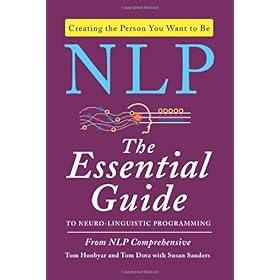
A New NLP Book is Published

Looks like there's a new NLP book out. Stan Rockwell has reviewed the recently published, NLP: The Essential Guide to Neuro Linguistic Programming at the @PsychCentral blog. You can read the review here. I trotted along to Amazon.co.uk and found the book on sale for £7.58, which is pretty good value for a 464 page book. Conveniently I only remembered my self-imposed moratorium on book purchases after the thing was bought and leaving the Amazon depot.

Rockwell gives a pretty positive review; he does comment on the amount of jargon filling the pages and that can't be denied; but he he goes on to say that he's been using the techniques described in the book and doing the exercises and they've been working for him. My criticism here is that yet again we have a book re-packaging NLP as an easy guide. 

What we actually need is someone developing new models, researching the effectiveness of what we already have or applying NLP in new and interesting contexts - as my friend and colleague Chris Mitchell does in her excellent Behaviour Management Toolkit reviewed by me here. I seem to remember John Grinder, one of the co-founders of NLP, talking in a YouTube clip of the need to 'replenish the well'. It's a good metaphor, as you would expect from Grinder, because of course if everyone draws water and the well is not replenished then eventually the well runs dry.

I've been having a fun time with NLP at the moment. I'm teaching the principles of NLP and drawing on my experience of using NLP as a therapist to groups of psychology students at the college where I work. Teaching this stuff has really helped me reach an even better understanding of NLP. In particular I'm really appreciating the 'explanatory power' of the approach when, for example, the class and I explore the psychology of negative emotional states - often called 'disorders' - though 'differently ordered' might be a better term; and I'm appreciating the creativity of NLP and the strengths based approach to therapeutic work: helping clients to access resources and creating choice about how they'd like to feel.

Sunday, 27 January 2013

Book Review: The Examined Life by Stephen Grosz

This little book of case studies has created a buzz in the small world of counselling and psychotherapy. It's been reviewed by the Guardian here, by the Observer here and by Rory of counsellingtutor.com here. Chapters have also been broadcast on BBC Radio Four's Book of the Week and can still be heard on the Marsden Therapy Podbean page here.

I'll start my review by mentioning a major reservation I have about the book in respect of client confidentiality. I accept that Grosz has protected the anonymity of his clients by changing names and details. I don't know how well disguised his clients are or whether they would recognise their private tribulations within the pages of his book. I don't know whether Grosz obtained consent from his clients or if  his clients knew when they attended psychotherapy that Grosz was collecting stories for a future publication.Maybe Grosz didn't know that either. It's a mistake to think that anonymity is the same as confidentiality. Whilst anonymity protects the identity of the client, the principle of confidentiality guards not only the client's identity but - within limits - everything the client says. Of course one of the book's selling points is that it provides an insight into the private world of psychotherapy, but I remained uneasy as I read these very personal case histories, transformed into very beautiful stories.

The book itself contains thirty-one brief chapters in which the author considers both the process of psychotherapy and the lives of his clients. With deep understanding he reflects on what he finds there, pointing out the unconscious motivations behind human behaviour, showing how apparently irrational choices make sense in the wider context of early experience and the need to protect the individual from something much worse. So jealousy protects us from the fear of being abandoned and paranoia guards us against the fear of being alone. Sometimes Grosz's conclusions are ingenious, sometimes speculative, but always thought provoking. There is great wisdom and humanity in this book. Reading the book as a counsellor I was inspired and encouraged to keep listening to my clients and to continue helping them to tell their stories.  

Wednesday, 2 January 2013

Visualisation in Person Centred Counselling - The Approach of David Rennie 3 of 3


Here is my third and final screencast on the Person Centred Approach of David Rennie. Here I outline his use of visualisation - were the counsellor (if appropriate) shares the visual images and metaphors evoked  in him or her by the client's story. Rennie suggests this can lead to 'vertical development' - a deeper exploration of the client's material as he or she pauses to reflect on what the counsellor has offered and how it relates to their recollection of the experience.

Thursday, 22 November 2012

Mindfulness

Last Sunday my friend, counselling colleague and peer supervisor, Mrs Jean Clements of Burnley, drove down the motorway, Google's directions in hand, for a Mindfulness workshop in South Manchester. 

It was a lovely day, cold and crisp and sunny. We arrived at Aileen's Mindfulness training to be greeted by the most beautiful, golden-coloured cocker spaniel by the name of Ruby. Each time the training session began and it was time for Ruby to be put in a separate room she would come and sit by me for protection - clearly a good judge of character, you cannot fool our canine friends! It did no good - she was still shut in her room. 

A nice surprise was to see one of my students there - Fleur - who had alerted me to the training and who fell in love with Ruby as we all did and later in the day took her for a walk.

The Mindfulness workshop began with eight students and two facilitators choosing a sultana. We were then given our first lesson in Mindfulness. Obviously my initial thought had I not been in a Mindfulness workshop would have been to throw the sultana into my mouth and swallow it down. In fact I cannot remember putting a single sultana in my mouth - why would you when a handful can be eaten instead? We were encouraged to roll the sultana around the palm of our hands, smell it, place it on the lips and to put it in the mouth to taste it, then bite it and after a long time swallow it down. We did all of this whilst paying attention to our senses and the sensation of having the sultana in our hands and mouth. Memories of my mother's baking, Christmas and vineyards in Italy were unlocked for the group. We went on to learn meditations that focused on the external and internal world and meditations during which we focused on our breathing; finally we all laid on the floor and experienced a mediation called the 'body scan'. I left the workshop feeling very relaxed and promising myself that I would incorporate mindfulness into my daily routine (and I downloaded the app).

So what is Mindfulness then? Well, my understanding is that it is an antidote to the society we have created  in which we are always busy and where we spend a great deal of time distracting ourselves from our feelings. Mindfulness is about focusing 'in the moment' on our experience and on our selves. That was my experience on Sunday, for once the world stop spinning and I could literally catch my breath.

Monday, 1 October 2012

Gay Cures and Red Hair

Yesterday the Guardian published an article on the passing of laws in California to outlaw gay conversion therapy: California banishes controversial 'gay cure' therapies to 'dustbin of quackery' Democrat Governor Jerry Brown signed the Bill making California the first state in the Union to outlaw the use of gay conversion practises on children and young people. A victory then for humanity and common sense!

Meanwhile a letter from the British Association for Counselling and Psychotherapy (BACP) drops through the letter box at Marsden Towers. The first 'Statement of Ethical Practice' and one in which the BACP echo the views of the Pan American Health Organisation (PAHO) and the World Health Organisation (WHO) stating that 'practices such as conversion or reparative therapies "have no medical indication and represent a severe threat to the health and human rights of the affected persons".' It goes on to say that 'the diversity of human sexualities is compatible with normal mental health and social adjustment' and concludes, 'BACP believes that socially inclusive, non-judgemental attitudes to people who identify across the diverse range of human sexualities will have positive consequences for those individuals, as well as for the wider society in which they live'.

These two developments are to be hugely welcomed - victories against the homophobia espoused by the religious right in the UK and America. Unable to accept that God might have created gay people along with everyone else, the religious right push the idea that being gay is a 'lifestyle choice' and inherently sinful or pathological. In my view being gay is as much a choice as being left handed or having red hair. You may know that left handed people were once also persecuted by the Church whilst people with red hair are in a minority and subject to insults from a society with thatches of plain black and mousy brown.

Can we extend the metaphor and liken gay conversion therapy to hair dye for people ashamed of their red hair? Keep applying the dye if you must, but deep down your hair is still red and will emerge and be  restored to its former glory when you're more comfortable with yourself and your natural hair colour. It's so you!


Monday, 17 September 2012

Trauma in Northern Ireland

My copy of Therapy Today, the magazine of the British Association for Counselling and Psychotherapy (BACP), arrived at the weekend. Inside there was an interview with Helena Stuart, a psychotherapist at The Wave Trauma Centre in Belfast.

In her interview Helena says that despite the fragile peace in Northern Ireland there is still a big need for trauma counselling. It is, after-all, in the aftermath of conflict, during times of peace, when we are often most vulnerable to the affects of trauma; when we cease coping with the crisis around us and begin processing, experiencing and reliving the traumatic events we have survived. 

One recent study found that the suicide rate amongst middle-aged men in Northern Ireland has doubled since the Good Friday agreement, further evidence of the difficulties many have coping with the transition to peace. These men grew up when violence in Northern Ireland was at its height and its made them susceptible to mental health problems in later life.

Helena says that as life in Northern Ireland returns to something like normality the symptoms of trauma begin to appear but not just in those directly affected. She says the effects of trauma are 'reverberating down the generations', affecting adolescents and children aware of but unable to talk about the unspeakable trauma their families have experienced. 

Reading the interview I was reminded of a visit I made in 1992 to Belfast's Museum and Art Gallery on the edge of the Botanical Gardens. I was a philosophy and politics student at Queen's University at the time. There was an exhibition of children's paintings. Those painted by the youngest children, only four or five years old, featured big yellow suns and bright red tractors; but as the children aged the colours became darker, the scenes increasingly bleak. Teenagers painted scenes of violence with military helicopters overhead.

Helena works creatively with her clients, they paint and use sand play to help symbolise the horror they have experienced. She says, "The symbols of healing appear in the sandbox even when the person themselves hasn't found healing yet. The potential is there and we always grow towards potential'.


Friday, 17 August 2012

Taming the Black Dog


A friend and counselling colleague gave me a copy of Taming the Black Dog. I'm often on the look out for self-help books I can recommend to my clients. Something to replace the classic by Susan Jeffers: Feel the Fear and Do it Anyway. Published in 2004 and written by Patrick Ellverton, Taming the Black Dog is a guide to beating depression, the Black Dog of the title.

Ellverton's book does contain a lot of good advice about healthier eating, exercise and the benefits of keeping a daily log. Ellverton recommends finding a mentor and writes admiringly  about his own source of  inspiration, Winston Churchill. There's advice on creating a daily regime of walking and prayer (or meditation) to 'restore the balance' and keep the black dog at bay. There's also advice on alcohol misuse whilst another section contains a twenty minute exercise routine. The guidance I personally found most useful was the recommendation to spend time in the evening planning the next day's tasks.

Ellverton's advice is rooted in a lifetime of coping with depression. Ellverton was an army officer and this too is reflected in his book. You can see from the description I've given that the book has a 'pull yourself up by the bootstraps' quality. He eschews counselling as tending to do more harm than good, though he offers a counselling service on his website.

I suspect Ellverton sees counselling as backward looking - a fruitless examination of unhappy past experiences likely to make depression worse. It's certainly true that rumination is a big part of depression and in my work as a counsellor I don't encourage clients to constantly dwell on their misery. I seek to acknowledge distressing memories and current unhappiness but recognise too the client's heroic side and the possibility of change.

Ellverton sees medication as a way of managing the symptoms of depression in the short-term whilst the depressed person makes changes to his or her thinking, behaviour and lifestyle. I have sympathy with that view and the need for lifestyle changes.

So Ellverton advocates a set of new habits: walking, exercise, playing a musical instrument, prayer, healthy eating and sobriety 'to keep the black dog in its kennel'. Anyone who likes this approach and can follow his prescription will find Ellverton's book helpful - replacing the behaviours that maintain depression with new behaviours that promote good mental health. The only problem is that depression tends to take away the motivation and will power needed to  make these changes. If that's the case for you then maybe some kind of therapy might be helpful.

Taming the Black Dog is available on Amazon here 

Wednesday, 13 June 2012

The Courage to Create

In a break from marking essays I have just finished reading The Courage to Create, a short and delightful book by the existential psychotherapist Rollo May. I was motivated to read more of Rollo May by the video I watched and reviewed here. This deeply humane and thoughtful book was a nice antidote to the last book I finished, by the much more combative Thomas Szasz.

Rollo May's book is about the creative process. A painter himself, he draws many of his illustrations from the visual arts as well as science and psychotherapy. The title comes from May's belief that creativity is a courageous act: the discovery of 'new forms, new symbols, new patterns' challenges conformity within society, and the creative genius is often punished for it.

May writes a lovely chapter on creativity and the unconscious, exploring the experience we have all had in which we apply ourselves to a problem for days only to have the answer come out of our unconscious when we finally put our pen down, have a rest or go for a walk. My old teacher used to say 'leave it to the night shift' and he meant just this, let your unconscious mind work on the problem and it will come up with the answer. May argues that the mind needs the 'relaxation of inner controls for the unaccustomed idea to emerge' (63).

My favourite chapter though is May's meditation on 'creativity and the encounter' in Chapter Four. He argues that great art comes out of the encounter between subject and object, between, for example, the painter and the landscape. He argues that the intensity of that encounter, the passion or commitment involved, determines how great that art will be. It also brings with it anxiety (92).I love this idea of the encounter and I immediately applied it to my work as a psychotherapist. Out of the encounter between therapist and client - or out of the client's encounter with self - out of the intensity of that - come new perceptions, realisations, insights and profound change. And yes, it certainly requires courage!

Thursday, 7 June 2012

Walking with Power and Grace

There was a flutter in the chicken coop this week as research published in the British Medical Journal strongly suggested that exercise does not help with depression (see the Guardian report here). 

The claim seemed counter-intuitive, but the evidence was pretty conclusive. People with experience of depression protested (see here and here), whilst Clare Slaney saw a hidden agenda at play - the dread hand of austerity around the throat of the prescription gym membership.

There has been evidence that exercise helps with depression (see, for example, the BBC News website here and here) and what about all those endorphins that exercise releases? On Twitter Professor Cary Cooper said the study focused on severe depression only. I'd like to read the BMJ to see for myself, but it's by subscription only and times are tough.As compensation there was a pretty well balanced report, reminding us that this study tested prescribed exercise only, in the Daily Telegraph here.

If the study did involve only those living with severe depression then I can well imagine how exercise came out as ineffectual. Might as well whistle down a storm. But thinking of the guys I have helped - people with moderate levels of depression - life style changes have often been beneficial. Sometimes it's difficult to work out whether people become more active as their depression lifts; or is it that the depression lifts and enables them to become more active?

I'm reminded of a story about Milton Erickson, the psychiatrist and hypnotherapist. He told a man living with depression to count the chimney pots on his way home from Erickson's house. The man did this, mainly to humour the old fellow; but by the time he had arrived at his own home he did feel quite a bit better. Erickson's intervention changed the man's thoughts, feelings and behaviours. Instead of looking down he was looking up, instead of ruminating he was counting chimney pots, instead of sitting at home on his own, he was walking down the street meeting people - you get the picture. The man had a strategy for maintaining his depression and Erickson flipped it round.

On some of the NLP training I've done I've been encouraged to walk with 'power and grace' and if you can behave differently then you will tend to think differently and feel differently. Like Gregory Bateson I think we're built that way - we are cybernetic.

Will walking with power and grace lift our mood? Possibly. Will it shift clinical depression? Probably not. It'll be the same with exercise (maybe).

Thursday, 17 May 2012

DVD Review: Rollo May and Existential Psychotherapy

This is a busy time of year for me. The courses I'm teaching come to an end, the assignments flood in and the marking begins. It's great to be able to give feedback and reward my students' hard work, learning and development with medals and missions; but marking is a time consuming business and results in numerous late nights and early mornings ... well, late nights mainly.

The last book I finished was Yalom's latest, but that was several weeks ago and I haven't started another yet. When I've a lot of work on I can't concentrate sufficiently to read and enjoy a book. Instead I tend to spend a lot of time flitting round the Internet: from Twitter to Facebook, to email and back to Twitter again. I learnt yesterday, from an article published by Science Daily, that this is indicative of depression. I'm not depressed, just suffering from a little bit of stress. In fact the research described in the Science Daily article makes a bit of a leap when it says flitting around the Web indicates an inability to concentrate and that indicates depression - I go with the first conclusion but hesitate at the second. 

So, unable or unwilling to dedicate time to reading I have hit upon a clever alternative. Several months ago I noticed that Psychotherapy.net DVDs were available for purchase on Amazon. I've bought them before, from the USA, and been slugged with a £28 import tax, so seeing them on Amazon and available in the UK was a pleasant discovery and flicked the 'buy me' switch in my mind - at this point imagine a railway line, a clanging bell and a locomotive carrying hard-earned cash towards Amazon INC's company HQ.

Despite the expense, watching DVDs of expert therapists working with actor/clients is great learning and very satisfying. I've recently watched Gestalt Therapy with a difficult to engage client and brief psychodynamic therapy with an elderly depressed client. My latest is an interview about existential psychotherapy with Yalom's own therapist, the existential psychotherapist and author, Rollo May. 

The sound and picture quality on the Rollo May DVD is pretty poor. It was made in the '80s on VHS - or possibly a machine that has a revolving foil drum. There is one camera, which pans around the participants when it might have more fruitfully remained exclusively on Rollo May. The participants are dressed for the1980s, early 1980s, when the moustache enjoyed a final blaze of popularity before its final death rattle and demise everywhere but Northern Ireland. 

The video has the flavour of the '80s for other reasons too. May constantly repeats his opinion that other therapies are 'gimmicks' - gimmicks in comparison to the therapy he practices, the therapy of Freud and Jung. Indeed he doesn't recognise short-term problem-focused therapy as psychotherapy at all. 

Remember that this is the time when managed care became popular and funding shifted from long-term psychoanalysis to short-term interventions and in particular Cognitive Behaviour Therapy (CBT). On reflection Rollo May seems rather zealous and intolerant of other therapies. We have come to accept the existence of a multitude of brief, outcome orientated or problem focused approaches.  For May they are quick fixes (gimmicks) whilst true therapy is a philosophical and mythological endeavour, an exploration of how to live the good life. I can sympathise with this, it treats seriously our existential concerns, but I see nothing wrong with helping clients to solve problems or reduce the symptoms of trauma and distress. May believes, with some justification, that these remedies are short-term and that symptoms return. Indeed symptoms tell us that all is not well, that we need to attend to the existential roots of our distress. 

There is no way to settle this dispute except to say that watching the DVD crystallised the problem for me at a time when I wasn't able to concentrate on reading any of the Rollo May books I have just bought for Summer reading ... from Amazon INC.

Thursday, 19 April 2012

Personifying Obsessive Compulsive Disorder (OCD)

In a recent blog post on Psych Central, Janet Singer wrote about her son Dan and his Obsessive Compulsive Disorder (OCD), which became so severe at one point that he was unable to eat. Distressed and confused Janet turned to a psychologist friend for help. He told her that Dan and his OCD were in a 'battle'. On good days Dan had the resources he needed to win the battle, on bad days the OCD over-powered him. This made a lot of sense to Janet and she began to refer to her son's OCD as 'the enemy'. She says it's a common approach to the treatment of OCD and enables the individual living with the condition to separate himself or herself from the 'disorder'. Janet says OCD is an 'insidious disorder' and that some 'battles' in the 'war' will be won and some lost, the important thing is that 'those suffering from OCD keep fighting'.

Over the years I've worked with many individuals living with obsessions, compulsions, and with OCD. I've been mostly successful in my helping, using a pluralistic approach, creating an individual therapy for each of my clients, using counselling, Cognitive Behavioural Therapy (CBT) and Neuro Linguistic Programming (NLP) .

Sometimes though I am unable to help. Often this is because the client has something else stressful happening in his or her life that constantly activates intense episodes of obsessive-compulsive behaviour. It's incredibly difficult to control OCD when the storm is raging. In those circumstances I offer support and I work with the client to resolve these 'external' sources of stress. If stressful life events happen whilst the client is having counselling then it's likely that he or she will have learnt strategies (1) to deal with this 'incoming' stress and (2) to manage their OCD. This usually prevents the OCD from escalating out of control.

In many ways I agree with everything that Janet Singer has said. One of my aims when working with clients living with OCD is to help them recognise and label OCD thinking; and it can be difficult to identify obsessive thinking when one is in the middle of it, the most irrational of intrusive thoughts can seem real when they are accompanied by intense feelings. But recognising and labelling OCD thinking requires the individual to stand outside of the OCD ; it is, I think, the first step towards mastery. It introduces the possibility of choice - 'This is my OCD wanting me to check the doors and windows of my house. Do I comply or do I not?' The next step may be to learn to tolerate the agony of not complying or not seeking re-assurance. There are many more rounds to go in this boxing match, but at this stage, and possibly for the first time, the OCD is on the ropes!

As you can see, it's very tempting to use a martial metaphor when talking about OCD. I've likened OCD to a boxing match, and Janet Singer uses words such as 'battle' and 'war'. Clients often use this kind of language when describing their experience of OCD and the process of recovery. When this happens I will often follow suit, working to create 'critical distance' between the client and their obsessions and compulsions, for the good reasons Janet Singer identifies in her blog post. I do have a reservation though about labelling OCD as the 'enemy'.

I worry that labelling OCD as the 'enemy' in effect creates a state of perpetual war within the individual, or possibly, periods of peace interrupted by fresh outbreaks of conflict.

These concerns come from my belief in the NLP pre-supposition 'all behaviour has a positive intention' and my training in the 'parts work' of family therapist Virginia Satir. In my view OCD is a 'part' of the individual and it has a positive intention. Like all anxiety disorders it is working incredibly hard at keeping the individual safe from harm. For example, when a person obsessively checks to see if their front door is locked there is a positive intention behind their behaviour, it is to keep his or her property and family safe and secure. In this context OCD isn't the enemy, it's the fire service, police force and National Guard all rolled into one. But of course whilst OCD behaviours might have a positive intention they nonetheless create havoc in the life of the individual living with OCD - this is a 'part' that needs retraining and re-assigning.

So, whilst I do help clients to personify their OCD - and use martial metaphors to 'defeat' the disorder - I may also look to re-assign or re-integrate a 'part' that is out of control by re-directing an individual's obsessive and perfectionist tendencies towards the perfection of a skill or hobby - I sometimes refer to the healthy obsession of the concert pianist. This means that time previously spent 'doing' OCD is spent having some fun and creatively filling the space that OCD used to occupy.


Saturday, 25 February 2012

Book Review: Psychological Therapy in Prisons

Harvey, J. and Smedley, K. (eds.) (2010) Psychological Therapy in Prisons and Other Secure Settings, Abingdon, Willan.

This book will be of particular interest to those counsellors and psychotherapists working within the criminal justice system. It contains an introduction and ten very well written chapters on therapy in prisons and secure institutions.

The early chapters describe a prison system struggling to cope with very high levels of psychological distress amongst an expanding prison population. The consequences of increasing demand and the reforms introduced to improve mental health services are expertly discussed in chapter two of the book.

The next four chapters describe how specific therapies can be used in secure settings. There are chapters on attachment-based psychodynamic psychotherapy, cognitive behavioural therapy with adolescents, cognitive analytic therapy with young adults and systemic therapy. Each chapter provides an outline of the model being used, its evidence base and its application. A case example is used to demonstrate the strengths of each approach and are a particularly interesting read. The problems inherent in providing therapy in prisons are discussed. One author describes prison as an ‘anti-therapeutic’ environment. The tension between security and care is a theme throughout the book.

The remainder of the book focuses on trauma work in prisons, there is a critical examination of therapeutic communities and an excellent final chapter evaluating the effectiveness of offender programmes. The chapters on therapeutic practice with women and therapy with black and minority ethnic people raise important issues that go beyond the context of prisons and secure hospitals. The chapter on race and the failure of the prison service to recognise the needs of black and minority ethnic prisoners is extremely powerful.

The book gives a particular view of psychotherapy in prisons as something practised by psychologists if it’s practised at all. The approaches discussed tend to be cognitive or psychodynamic. Neither Counsellors nor the humanistic approach feature in the book and Carl Rogers is mentioned once only - on page 250 – the book is 254 pages long! There’s no mention either of the work done by the chaplaincy or the listeners service - prisoners trained by the Samaritans to support their peers – which is currently under threat because of cuts in the prison budget. The book lacks a concluding chapter, which could have brought the key issues together and reflected on the overall picture. Despite these criticisms the book is an extremely interesting read and highly recommended for those interested in the health and care of prisoners or therapy with forensic populations.

Saturday, 26 November 2011

Book Review: The Heroic Client by Duncan, Miller and Sparks

The Heroic Client is wonderfully polemical – a fearless examination of contemporary medical approaches to mental illness and its treatment. The book targets the pharmaceutical industry and the psychoactive drugs it produces. It attacks the medical model and its tendency to define mental illness reductively in terms of ‘biochemical imbalance”. The authors are sceptical of approaches that stigmatise individuals and reify the causes of mental illness by applying biological models and questionable diagnoses - an approach that turns clients into passive recipients of behavioural treatments and tablets. The authors ask for clients to be cast in a different light - competent, resourceful, and resilient – with the agency and self-efficacy to find solutions and make positive changes.

The book begins with a chapter entitled, “Therapy at the Crossroads”, in which the authors warn of a situation developing in which counsellors and psychotherapists exclusively work for medical practitioners. In these circumstances the medical model becomes the only way of explaining mental illness, with the therapist as an adjunct to medication, a fixer of broken people. In chapter two the authors challenge the supremacy of the medical model, calling into question the evidence base on which it rests and suggesting other constructions of mental health and mental illness that include the social context and the personal history of the client.

At the heart of the book are three chapters that provide an alternative to the established diagnostic approach. In examining the client’s story for signs of pathology the medical model misses an alternative interpretation of the client’s experience, one in which the client endures or overcomes trauma and loss through the discovery and use of social networks and inner resources. The ‘heroic client’ has a different tale to tell once he or she is freed from the template imposed on them by pathologising and medicating mental health professionals.

To support the heroic client practitioners ensure their therapy is client directed (chapter three) and outcome informed (chapter four). In my favourite chapter, rich with case material, the book highlights the importance of identifying and exploring the client’s theory of change (chapter four). The authors refer to research carried out on the innovative hypnotherapist Milton Erickson in the 1980s. Nobody could quite understand how he worked out which intervention his clients needed for recovery to take place. Eventually the researchers realised that Erickson didn’t know either, but that his clients did. Erickson listened to his clients and from them he discovered what they needed in order for therapeutic change to take place.

The book contains a critical examination of psychoactive medication. The fact that so many children are being prescribed stimulants and anti-depressants ought to concern us all. The authors explain just how flimsy the evidence is supporting anti-depressants, with many proving hardly more effective than placebos. So, this book is a cri de coeur – urging therapists to stand against the drug companies and the medical model and to listen instead to clients and their heroic stories. A very good read!

Sunday, 6 November 2011

Book Review: Integration in Counselling and Psychotherapy by Lapworth and Sills

I teach on a counselling course that requires students to make sense of a number of different approaches to therapy; so I've been giving a lot of thought to integration and how it can be successfully achieved. After reviewing Cooper and McLeod on my blog here I have turned my attention to Lapworth and Sills and the second edition of their Integration in Counselling and Psychotherapy. The two books are similar because both are concerned with giving the reader an over-arching framework to help make integration possible; but whilst Cooper and McLeod provide one approach to integration - pluralistic counselling and psychotherapy - Lapworth and Sills provide an overview of what is needed if integration is to be achieved, their own model of integration - the Multi-dimensional Integrative Framework - and brief chapters on four other approaches, including a chapter on the therapeutic relationship and an outline of Multi-modal Therapy.

I am trying to work out why I disliked the first part of Lapworth and Sills. I found it too theoretical. I was left wondering how I had managed the task myself of integrating different counselling approaches. I was reminded of the cartoon strip in which Garfield the cat is stuck on the stairs after wondering how on earth he was able to co-ordinate the movement of his four legs. I could be at fault because I'm more of an activist when it comes to learning, which may also explain why my favourite chapter in the book is a case study of the Multi-dimensional Integrative Framework in action. But I don't think it's the theoretical nature of the material in these early chapters that's the problem, rather it's the lack of time taken to explain and illustrate what is being said. I was left with the sense of skating across the subject because of the authors' preference for summaries, outlines and bullet points. This tendency can also be seen at the end of the book when the authors give a brief outline of four competing theories of integration. It can also be seen in the first chapter where the authors give a potted history of integration in counselling whilst apologising because they don't have room to explore the topic further.

So for me the life saver, the thing that enabled me to go on reading, is the diagram on p89 and the case history that forms chapter six. Here the authors apply their Multi-dimensional Integrative Framework and the reader gets to see how useful it is as a model for explaining the problems experienced by the client, how these might be addressed (a formulation) and how therapy is progressing over time.

The authors argue in this book that in order for integration to happen successfully the therapist must have an over-arching framework that gives the therapist an understanding of human beings and of therapy and informs the choices the therapist makes about the strategies and techniques to borrow from different schools of therapy. It is the over-arching framework that gives those choices coherence and therapeutic power. I am reminded yet again of Yalom's point about creating a therapy for each client and I'm happy that ultimately Lapworth and Sills provide a way of doing that - and summaries of alternative frameworks that the reader can investigate further.

Wednesday, 26 October 2011

The Cycle of Change


A particularly useful model for counsellors and clients is the cycle of change, developed by DiClemente, Prochaska and Norcross and described in their very readable book, Changing For Good. The video (above) is an interview with Carlo DiClemente co-developer of the model. The cycle of change is an excellent tool for understanding the process of change and for identifying where people are in the process. The model also provides a guide to the interventions that best support individuals at different stages in the cycle. The authors argue that the wrong intervention at the wrong time may actually hinder the process of change, raising defences and entrenching denial in clients.


Before individuals enter the cycle they are in a stage that DiClemente calls “pre-contemplation”. As the name suggests, individuals in this stage may be unaware of their problem or deny that the problems exists or affects them. Denial is an active process that involves pushing a problem out of awareness and a fascinating subject in itself. The appropriate intervention in this stage of the cycle is consciousness raising through the provision of information. A successful intervention helps the individual to the next stage of the cycle, which DiClemente terms “contemplation”.

When an individual begins to consider the possibility of change he or she has entered the “contemplation” stage of the cycle. This stage is marked by ambivalence, commonly expressed by clients in the form: “Part of me wants to make a change but another part wants to keep things as they are”. Resolving this ambivalence is the key task for individuals before they can move to the next stage of the cycle.

Two approaches to resolving ambivalence can be employed here. The first approach to resolving ambivalence is to create within the individual a psychological state known as cognitive dissonance. This state occurs when an individual’s actions are in conflict with his or her values. Cognitive dissonance is resolved when changes are made to bring a person’s behaviour in line with their values. The second approach is the decisional balance exercise in which clients are invited to consider the short-term and long-term positive and negative effects of their limiting behaviour. This also increases levels of cognitive dissonance in the individual as they recognise that the long-term consequences of their behaviour are negative.

Ambivalence is resolved when the individual moves to the next stage of the cycle, the “decision” or “commitment” stage. In this stage the individual decides to make a change or makes a commitment to the change process. It is commonplace for individuals at this moment to slip back into ambivalence or, more helpfully, to move round the cycle a little further to the “action” phase. The counsellor can reinforce the client’s commitment to change through genuine praise and by focusing on the gains that will be realised once changes are made.

The action stage of the cycle is the point at which the client prepares to make changes. Methodical preparation is a key factor in successful change. Counsellors can support their clients in this phase of the process by helping with goal setting and action planning. Effective goal setting and action planning can create a compelling future that pulls the client towards the next stage of the cycle: the maintenance of new and desired behaviours.

In the maintenance stage of the cycle the individual successfully creates change in their lives and sustains it over a period of time. If change is maintained then permanent change takes place and the individual leaves the cycle. Maintenance requires conscious effort. Permanent change has occurred when the new behaviour has become automatic, natural or effortless. Helpful interventions in the maintenance stage of the cycle include “old self” v “new self” comparisons, listing the gains and good feelings associated with the new behaviour and importantly relapse prevention.

Preparing clients for the possibility of relapse may seem like a risky thing to do, as though acknowledging the possibility of a relapse might bring it on. But exploring and planning for a relapse is preventative work and provides the client with the knowledge and skills the will need to manage a lapse and return to the maintenance phase of the process. If a lapse turns into a relapse the counsellor can reframe the relapse as essential learning - another piece of the jigsaw – on the way to permanent change. DiClemente discovered that individuals tended to go round the cycle a number of times before reaching permanent change, but each trip round the cycle is developmental and prepares the individual for their next more informed attempt at change.

Sunday, 25 September 2011

Keep Listening in HM Prisons

I was concerned to read in a Guardian article here that the prison listeners service may be under threat because of government cuts. Prison listeners are trusted prisoners who volunteer to be trained in listening skills by the Samaritans. Whenever other inmates are feeling suicidal or depressed they are padded up with a listener who can then help them to talk and share their feelings. The article states that prisoners volunteering as listeners help the prison staff to manage suicidal and depressed prisoners. I have visited prisons that have a listener's cell on each wing. It's a little roomier than your average cell, in recognition of the valued work that's being done in there and the need for more space. Prisoners rightly wear their volunteering as a badge of honour because when you are a listener you are in a position of trust.

So the listener service benefits those prisoners experiencing distress because they have someone to talk to who has an idea what it's like to be in prison, separated from family and friends. It benefits the prison service because they are having suicidal prisoners monitored in a cost effective way. It helps to rehabilitate offenders because they are learning and applying listening skills underpinned by empathy and compassion and one of the greatest challenges in the rehabilitation of offenders is making up for deficits in empathy and compassion. So rather than cutting the listeners service I would expand it: teaching as many prisoners as possible basic counselling skills, running prisons in more democratic ways, modelling constructive rather than aggressive ways of using power. This approach has been used in Therapeutic Communities and in institutions committed to the principles of restorative justice. It needs to operate across the whole prison - inmates and staff - and is an alternative to the power dynamics that currently rage in HM Prisons, where might is right and were it makes complete sense to remain emotionally detached and physically aggressive.

Wednesday, 14 September 2011

New Term Excitement!


Next week I begin another term of teaching at my local HE college - the University Centre, Blackburn College. I'll be teaching a course called Contemporary Psychotherapies to two groups of BA(Hons) degree students. The course looks at Motivational Interviewing, Neuro Linguistic Programming (NLP) and Cognitive Behavioural Therapy (CBT) and evaluates what they offer to those working with difficult to engage young people and unmotivated adult clients. I'll also be teaching counselling skills to 'eager for knowledge' first year students on the Foundation Degree in Positive Practice with Children and Young People. All the sessions are written, with the resources ready and printed, so they'll be an absolute joy to teach!

Just as exciting are the two new foundation degree courses we are running in Counselling with Coaching and Mentoring and Counselling with Brief Therapies. I am mainly involved in facilitating the personal and professional development modules and I'll be a personal tutor too. In the second year I'll be teaching modules on Motivational Interviewing, Solution Focused Therapy and Group Work Skills. I can't wait for the teaching to start!

Thursday, 8 September 2011

Trainees and Personal Therapy

I think it's true to say that out of all the clients I have worked with, those in training as psychotherapists have initially proved the most trying. Not all of them. There have been notable exceptions where the trainee’s excited absorption in the theory and practice of psychotherapy has been duly match my devotion to an intrepid exploration of themselves from the start. One might expect that this would always be the case, but others have arrived reluctantly, even resentfully, seeing their attendance immediately as a course requirement rather than an opportunity for self-discovery and transformation. They see little, if anything, in need of discovering or transforming. This in itself is, of course, a self delusional problem, much in need of discovery and transformation. While I don't quite put it like that, I do suggest they go away and think about how they might want to use our time together therapeutically.

From ‘Not Playing it by the Book’ by Phil Lapworth in Lapworth, P. (2011) Tales from the Therapy Room: Shrink Wrapped, London, Sage

When I began my diploma in counselling thirteen years ago there was a requirement for twenty hours of personal therapy. In the end I had 50 hours and I've been back since, with different therapists, from different traditions, using different models of therapy. I see this as part of my personal and professional development, an investment in me as a therapist, committed to connecting with others and addressing those parts of me that unconsciously sabotage working at relational depth.

There is, of course, an argument which suggests trainee counsellors ought not to be forced to have personal therapy, that to make someone attend counselling contradicts the counselling ethos of promoting individual choice and autonomy. I see the point, but those same courses see nothing wrong with setting and assessing assignments, and the student who asserts their autonomy by not handing in their assignments doesn’t pass the course. Maybe that isn’t an appropriate comparison; I am not much good at rhetoric, despite a degree in Scholastic Philosophy, so let me instead promote the merits of personal counselling for trainees with a little list:

Personal therapy can promote self-awareness and reflexivity

It enables trainees to experience what it feels like for clients when they come for help

It's an opportunity to work on personal issues in a safe space. It provides a confidential place to take personal issues that may result from reflective practice and supervision

It’s much better to work on distressing experiences in personal counselling than to have them activated by a distressed client during a counselling session

Working with an experienced therapist provides an opportunity to model how they work and to experience a therapeutic relationship. It is also an opportunity to experience different approaches to therapy

I’d be interested to hear arguments against personal therapy for trainees, especially from those providing personal therapy. I think I will need some convincing before I stop advocating personal counselling for trainees. And if Liz Johnson my first therapist ever reads this – thanks for what you did Liz and how you did it!

Monday, 29 August 2011

Book Review: Person-Centred Counselling by David Rennie

This slim volume is an account of David Rennie’s approach to person centred counselling. The book started as a set of training materials, its ideas tested in the training room, but the book is also informed by Rennie’s own practitioner-research and by the suggestions of peers such as Mearns and Thorne. We are left with a short, lucid and well written account of Rennie’s ideas for developing the person centred approach and one that will undoubtedly improve the therapeutic skills of every reader.

At the heart of Rennie’s understanding is the client as reflexive agent. In other words the client’s job in therapy is to reflect on their experience and from that reflection arrive at a deeper understanding of the issues that confront them and the choices they can make. Rennie believes that greater understanding can lead to greater agency.

The therapists job is to keep the client on track with their reflections and to use empathic and process orientated interventions to deepen the client’s exploration. Empathic communication includes paraphrasing and reflecting, the interventions one would expect from a person centred therapist. But Rennie also advocates presenting the client with visual imagery and metaphors, symbolic representations that can emerge out of the clients experience as reported to the counsellor, or from the counsellor’s unconscious, in tune with the client’s experience.

There is an excellent chapter on transparency with sound advice on when counsellor’s ought to express congruency; but Rennie’s greatest contributions to person centred therapy are in his chapters on process identification, process direction and meta-communication. Rennie argues that therapists are able to deepen the clients exploration of their experience and the felt-sense associated with it by encouraging reflexivity, and this can be promoted if the therapist appropriately comments on the client’s process issues. At its simplest this involves pointing out what the client is doing: “As you said that you raised your eyebrows”. This brings into the client’s awareness thoughts and behaviours that were out of awareness and as a result the client becomes more self-aware. Rennie’s discussion of metacommunication invites therapists to deepen their relationships with clients by commenting on the meaning behind their own or their client’s communication.

There are some things I disagree with in Rennie’s book. I do not think, as Rennie does, for example, that it’s OK for the contracting process to become a “five minute routine”. I see the contract as part of the therapy and an opportunity to explore with the client their anxieties about therapy and issues such as confidentiality. But this small book has a great deal to offer therapists looking to deepen their contact with clients and I will be urging my students to read it.

Rennie, D.L. (1998). Person-Centred Counselling: an Experiential Approach, London: Sage