Counselling, Supervision, Training, Research, Teaching, Writing. Providing therapeutic services to the people of East Lancashire and beyond.

Saturday, 26 October 2013

The Marsden Window

I hope you can see the photo I took today of the whiteboard I was using during some teaching and learning. I've called it The Marsden Window, with a nod to Joe and Harry of Johari Window fame. I'm never sure what the 'share' feature on my phone throws out.

Though The Marsden Window is not particularly original it was effective this morning in communicating an idea I wanted to get across to a great-to-be-with group of counselling students at the University Centre where I work.

One of the drawbacks of a skills based approach to counsellor training, and this has been identified by David Rennie in his book, Person Centred Counselling: an Experiential Approach, is that learners inevitably focus on their next intervention rather than the experience of the client or their connection with the client. Quite often learners resort to asking fairly random questions and once the questioning begins it can be difficult to stop. Turning a counselling session into an interview in which the responsibility for the session and its direction shifts from client to counsellor. This can have a negative impact on the client's autonomy, on the session's  emotional depth and on the quality of the connection between client and counsellor.

So I had a brainwave, drawing a window (a square with four quarters to it) on the whiteboard and writing: 'connect to self', 'connect to other', 'core conditions' and 'active listening' in the four compartments. After using this model for a few hours I added another element, drawing a thick black line around the window - the window frame - symbolising the time boundaries and ethical boundaries that must be in place when counselling.

The aim of this model is to shift the focus from doing active listening to being in relationship with the client.

This is achieved by the counsellor connecting first of all to their own feelings and process. To achieve this the counsellor might ask, 'How am I feeling in this moment?' or 'How am I feeling today?' The effect of this is to centre the counsellor or connect the counsellor to his or her feelings and gives the counsellor an opportunity to put difficult feelings to one side and hopefully become more emotionally available, more able to sense the feelings of the client. Students found this very helpful and there was a strong sense of the sessions slowing down and the counsellors becoming more thoughtful. Also cliens became tearful and more emotional and in feedback said they felt supported, listened to and accepted.

The next stage of the model sees the counsellor connect with his or her client. Here the opening question is important and ideally invites the client to do what the counsellor had just done: connect to process and feelings and join the counsellor in this 'place of feelings'.

The next part of the model acknowledges the importance of Rogers' core conditions: the importance of empathic understanding, of accepting and prizing the client, or more importantly of the client feeling accepted and prized.

Then we arrive at active listening, but there is a greater chance that this active listening emerges out of a deep rapport with the client and is imbued with the core conditions.

When using this model I observed a qualitative difference in the way students were listening to each other and a move towards the bellybutton-to-bellybutton communication I was looking for.

I'm going to keep reflecting on the teaching and learning of counselling. A recent Higher Education Academy Report states there is little evidence on the best ways of teaching and learning counselling. It fits also with the research aims of UCBC where I work.

Thanks to the four students I worked with today. I learnt a lot.

Saturday, 5 October 2013

Return of the Blog

It's been a while since I posted anything on this blog. First there was the pressure of work and then the summer weather was gorgeous and I needed to rest after an intense year of teaching. So I left my desk for the great outdoors - St Anne's on Sea, Morecambe and the local park - where I relaxed and read books unrelated to counselling and mental health. Or so I thought, but as one of my ace students pointed out, Jon Ronson's The Psychopath Test, Rebecca West's The Return of the Soldier and Syvia Plath's The Bell Jar are all psychology related. Plath's novel, by the way, is not only brilliant but as compelling a description of major depression and post traumatic stress as I have ever encountered.
So, away from my desk, I stopped blogging, tweeting, scooping and all those other social media verbs and enjoyed the warmth of the sun. But now I'm back in the saddle, and like John Wayne in The Searchers, I'm going to hunt down some ideas and present them in future blogs for my own enjoyment and yours too. That might be the first time I have addressed 'the reader' directly (her name's Amanda).
Farewell for now, I hope you all had a pleasant summer and if any of my new students are visiting this site, welcome aboard!

Friday, 1 March 2013

A New NLP Book is Published

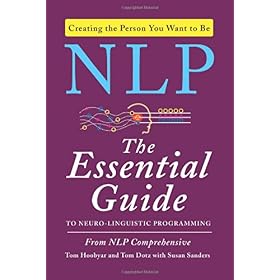
Looks like there's a new NLP book out. Stan Rockwell has reviewed the recently published, NLP: The Essential Guide to Neuro Linguistic Programming at the @PsychCentral blog. You can read the review here. I trotted along to Amazon.co.uk and found the book on sale for £7.58, which is pretty good value for a 464 page book. Conveniently I only remembered my self-imposed moratorium on book purchases after the thing was bought and leaving the Amazon depot.

Rockwell gives a pretty positive review; he does comment on the amount of jargon filling the pages and that can't be denied; but he he goes on to say that he's been using the techniques described in the book and doing the exercises and they've been working for him. My criticism here is that yet again we have a book re-packaging NLP as an easy guide. 

What we actually need is someone developing new models, researching the effectiveness of what we already have or applying NLP in new and interesting contexts - as my friend and colleague Chris Mitchell does in her excellent Behaviour Management Toolkit reviewed by me here. I seem to remember John Grinder, one of the co-founders of NLP, talking in a YouTube clip of the need to 'replenish the well'. It's a good metaphor, as you would expect from Grinder, because of course if everyone draws water and the well is not replenished then eventually the well runs dry.

I've been having a fun time with NLP at the moment. I'm teaching the principles of NLP and drawing on my experience of using NLP as a therapist to groups of psychology students at the college where I work. Teaching this stuff has really helped me reach an even better understanding of NLP. In particular I'm really appreciating the 'explanatory power' of the approach when, for example, the class and I explore the psychology of negative emotional states - often called 'disorders' - though 'differently ordered' might be a better term; and I'm appreciating the creativity of NLP and the strengths based approach to therapeutic work: helping clients to access resources and creating choice about how they'd like to feel.

Saturday, 23 February 2013

Chris Parry-Mitchell and The Behaviour Management Toolkit


I have been good friends with Chris Mitchell for a while now and this week had the pleasure of her company over coffee and a cup of tea in Blackburn's nicest cafe, The Coffee Exchange. It was great to see her again, happy and healthy. It was a great chance to catch up, and for me to talk at length about David Allen's book, Getting Things Done, and my personal quest to improve workflow and productivity. Not only did Chris stay awake during this (and she was drinking tea, not coffee) but she listened and gave good advice and inspired me to make changes; but what else would one expect from the author of The Behaviour Management Toolkit? 

I have to declare an interest at this stage, because not only is Chris a friend of mine, but we also share a common perspective on working with people and have similar training, often with the same Neuro Linguisitc Programming (NLP) practitioners and trainers. Indeed there are many similarities between Chris's work on avoiding exclusion from school and the Proactive Carer Programme I developed and delivered with my friend, Adam Gibson of Lancashire Counselling Services. Both draw on NLP and Transactional Analysis and both share a common ethos, the fundamental principle that if you help people develop resources they will have more choices and their behaviour and circumstances will change in positive ways. There are other shared principles: the power of groups and group work and the need for passionate and committed leadership that encourages and equips individuals with the knowledge and skills to make small but significant changes. I often use a metaphor that someone gifted to me, that if you sail from Portsmouth to New York and you're one degree out at the beginning of your voyage, you'll be in a different country by the time you've crossed the Atlantic. Fine if you don't mind landing in Canada, but you get the idea: small changes over time yield significant results.

So what's in The Behaviour Management Toolkit and how useful might it be to teachers and trainers working with young people at the point of being excluded from mainstream education? It's a ten session programme, with all the handouts and worksheets on a CD-ROM taped to the back page. It aims to equip young people with the insight and skills needed to make different decisions, change their behaviour and get better outcomes. Almost 300 children have been through the programme run by Chris in Preston, Lancashire, and  more than 80% of those have remained in education. Now this could be the programme, it could be the expertise of Chris and her two colleagues, John and 'Swifty' (Andrew 'Swifty' Swift is an old student of mine, but I take no credit for the excellent practitioner he has become). More likely it's a combination of these factors as well as the potential all young people have to seize an opportunity to change when they are given the chance by adults who appreciate their struggles and care about their futures!

The Behaviour Management Toolkit applies some classic NLP patterns: the Mercedes Model, submodality shifts and an extremely effective perceptual positions exercise to educate group members about their own thoughts and feelings, the impact of their behaviour on others and why that matters. It uses ideas from TA (warm fuzzies, cold pricklies, the Drama Triangle and game playing) to help young people understand and take responsibility for how they communicate. Each session begins with participants identifying and sharing their achievements that week, creating positive feelings, generating positive feedback and helping to change internal filters so a young person starts to notice what's going well in their lives and not just what's going badly. The whole programme is well put together, so each session builds on the previous  one and models learnt early in the programme are reapplied later on. Chris says she responded to feedback  from her young participants, making changes and increasing the programme's relevance and effectiveness. I think it's a superb piece of work, but the ultimate test is, does it work? Well, the statistics and the participants' feedback says it does; and whenever I've visited the project I've noticed an atmosphere that's warm and safe and purposeful, and the young people I've met there are full of praise for Chris and her team.

I hope practitioners working with hurt young people and their sometimes challenging behaviour make use of the Toolkit. In a previous career I delivered offender programmes for the National Probation Service. These were based on the principles of Cognitive Behaviour Therapy, an approach I much admire, but which, in that context, lacked the optimism and the humanistic underpinning found in The Behaviour Management Toolkit. I use it when teaching NLP based interventions to students on the BA (Hons) degree Working with Children and Young People at The University Centre at Blackburn College, a course that 'Swifty' graduated from several years ago! Congratulations to Chris Mitchell and her team, changing lives and living your mission!